


By Rev. Harry Edenfield
“I WAITED PATIENTLY FOR THE LORD; HE INCLINED TO ME AND HEARD MY CRY.” PSALM 40:1
Years ago, I was asked by his parents to identify the body of their teenage son. As I drove home from the hospital, my tears did not hide the fact that other drivers were not sharing my grief. A strange solitude.
Death is a trumpet call to gather. The theologian Augustine encourages us: “Let us mourn in company; let us weep together.” Shared sorrow reminds humans that we have death as a common enemy and sin as an innate trait. When death “wins,” we have a mutual loss.
In grieving over His people’s idolatry, the Lord God speaks: “Consider, and call for the mourning women to come; send for the skillful women to come; let them make haste and raise a wailing over us” (Jeremiah 9:17b-18a). These professional mourners are called to demonstrate a public commemoration of sorrow.
Even as God sees our tears, He mixes His sorrow with ours. God invites the whole world to read what He sees: the murdered body of Abel. To Cain: “The voice of your brother’s blood is crying to me from the ground” (Genesis 4:10b).
God consistently shares sorrow publicly. “And (Jesus) said, ‘Where have you laid (Lazarus)?’ They said to him, ‘Lord, come and see.’ Jesus wept. So the Jews said, ‘See how he loved him!’” (John 11:34-36).
My beloved brother Dan Edenfield died in 1998 at age 49. As an Allen County, Ind., sheriff, he was handling security at the War Memorial Coliseum in Fort Wayne. Dan took responsibility seriously. He died within three hours from a heart attack sustained while chasing a “bad actor.”
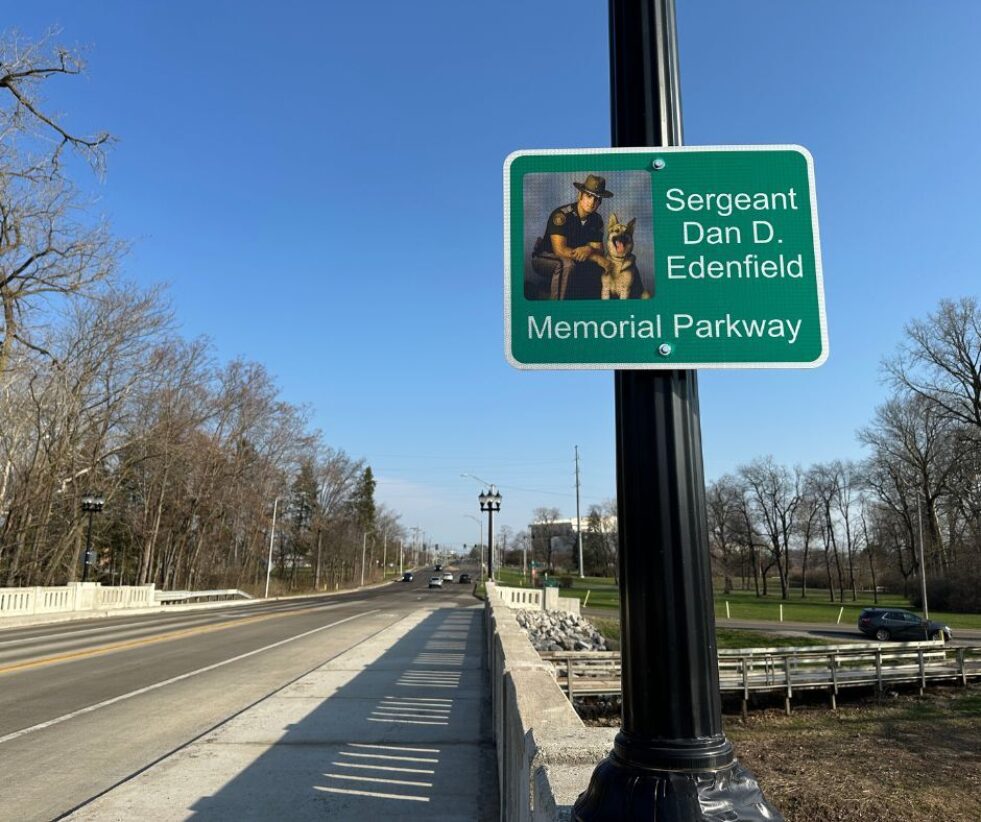
In October 2025, Dan posthumously received a great honor from officials of Fort Wayne and Allen County. A section of Parnell Avenue, bordering the Coliseum, was renamed Sergeant Dan Edenfield Memorial Parkway. The ceremony was attended by dignitaries, police officers, and family. Dan was honored and grieved through shared words.
Some of Jesus’ final words to His disciples were about sharing sorrow: “You will be scattered, each to his own home, and will leave me alone. Yet I am not alone, for the Father is with me. I have said these things to you, that in me you may have peace. In the world, you will have tribulation. But take heart; I have overcome the world” (John 16:32b-33).
I was vacationing hundreds of miles away the day my brother was honored. My absence was not out of avarice, but rather my lack of appreciation for sharing enduring sorrow. Sorrow always lingers. God wants us to continually comfort each other. The Father comforted Jesus; Jesus comforts us.
Some God-searching and self-searching have led me to where I should have been in October 2025. God created us as one race, one human family. He called us to salvation as one redeemed family. To all God-pleasing gatherings, God calls us to interact with His people with kindness, understanding, and love in worship and in sorrow.
One day, shared sorrow will become a shared song: “All tribes and peoples and languages, standing before the throne and before the Lamb, clothed in white robes, with palm branches in their hands, and crying out with a loud voice, ‘Salvation belongs to our God who sits on the throne, and to the Lamb’” (Revelation 7:9b-10).
This month’s study text:
David’s Child Dies
15 And the LORD afflicted the child that Uriah’s wife bore to David, and he became sick. 16 David therefore sought God on behalf of the child. And David fasted and went in and lay all night on the ground. 17 And the elders of his house stood beside him, to raise him from the ground, but he would not, nor did he eat food with them. 18 On the seventh day the child died. And the servants of David were afraid to tell him that the child was dead, for they said, “Behold, while the child was yet alive, we spoke to him, and he did not listen to us. How then can we say to him the child is dead? He may do himself some harm.” 21 Then his servants said to him, “What is this thing that you have done? You fasted and wept for the child while he was alive; but when the child died, you arose and ate food.” 22 He said, “While the child was still alive, I fasted and wept, for I said, ‘Who knows whether the LORD will be gracious to me, that the child may live?’ 23 But now he is dead. Why should I fast? Can I bring him back again? I will go to him, but he will not return to me.”
2 Samuel 12:15-18, 21-23
Reflection Questions:
How does this passage from 2 Samuel demonstrate that “shared sorrow” is not always exhibited in the same manner?
How was the little boy an innocent victim? How was he not an innocent victim? Who pronounced the final verdict?
At his son’s death, David’s fasting stops and his sorrow calms. What caused this seemingly emotional contradiction?
Prayer:
Father, Your sorrow over death in creation and our sorrow as a part of a dying creation was not Your intended outcome. Jesus, thank You for being the sacrifice for our sins and the resurrection for our hope. Holy Spirit, thank You for bringing us together in this shared but hopeful sorrow. Amen.
The Rev. Harry Edenfield is the pastor emeritus at Christ The King Lutheran Church and School in Southgate, Mich., and an author for Worship Anew’s Hope-Full Living devotional.
Above photo by Ashley Wiehe: A sign stands on Parnell Avenue in Fort Wayne, Ind., as a memorial to Sgt. Dan Edenfield, brother to the Rev. Harry Edenfield. Sgt. Edenfield died of a heart attack in the line of duty in 1998. The sign was hung in his honor in 2025.