


FOUR “WORSHIP ANEW” PASTORS REFLECT ON THEIR DECADES OF PREACHING ON THE PROGRAM
Every October is Pastor Appreciation Month for the church. It’s a time for us to honor the pastors who guide us in our faith. This month, we asked four of our longest-serving “Worship Anew” pastors to write and reflect on their time of sharing the Gospel with aging adults through our program. We are grateful for their service and all that they do to share the Gospel with aging adults!
The Rev. Dr. Walter Maier III is a current pastor on the program. He has served on the program since 1998.
The Rev. Richard Koehneke has retired from the program, having served from 1994 to 2009.
The Rev. Paul Shoemaker is a current pastor on the program. He began serving in 1994 and is the longest-serving pastor for “Worship Anew.”
The Rev. Dr. Dan Brege is a retired pastor for the program, having served from 1992 to 2018.
A personal connection through ‘Worship Anew’
By Rev. Dr. Walter Maier III
For me it is a tremendous privilege to be sharing the Gospel with aging adults through “Worship Anew.” This program is God’s instrument to bring his comforting Good News into homes, nursing homes, hospitals, and other places in this country and around the world. Being part of such a ministry is also an awesome responsibility, because God’s Word is being carried to many people for their everlasting welfare. All praise and honor go to the Lord, who has sustained and expanded the outreach of “Worship Anew” (originally “Worship for Shut-Ins”).
“Worship Anew” has meant much to me on a more personal level, as well. In the last years of their earthly lives, my father (who died in October 2019), mother (who died in March 2025), father-in-law (who died in May 2026), and mother-in-law (who died in November 2024) were not able to go to church. They did, however, regularly watch “Worship Anew” and were spiritually edified and strengthened through the Word which they saw and heard.
“Worship Anew” meant much to them and so it meant much to me! They frequently expressed their gratitude for the program, and when I was the preacher, they gave me beautiful words of encouragement. Sometimes I had the opportunity to watch “Worship Anew” with them. Those are treasured memories, as together we listened, sang, and prayed.
Thus, when preparing a message to be preached on the program, I would have one or all of them in mind. I was aware of challenges they faced and how their lives changed as they advanced in years. In addition, I became acquainted with their neighbors who were also aging adults. They, too, and their particular circumstances, were in view as I wrote homilies for “Worship Anew.” In reading through and teaching Scripture (I am a professor at Concordia Theological Seminary in Fort Wayne, Ind.), my thoughts, in part, would be how the individual passages would apply to these people and could bring them comfort, strength, and encouragement.
However, in preaching to others I, at the same time, am preaching to myself. First and foremost, that is because God’s Law and Gospel apply to all people — of all ages and in all situations. We all need to be humbled by the Law, which shows us our sins and the need we have for the Savior. How necessary it is, then, to hear the Gospel, which presents to us our Savior Jesus Christ and how through faith in Him we have forgiveness and everlasting life! Christ leads us as our Good Shepherd and gives to us through His Word and Supper the strength we need to live as His people.
Another reason, though, that I am preaching to myself is that I am getting older. As the saying goes, none of us is getting any younger! Caring for my parents and in-laws gave me a proper perspective on this life and reminded me of what could lie in the future for me. Nevertheless, in witnessing their strong faith in the Lord, their continual joy in Christ, and the blessed end of their earthly sojourn, I was given the wonderful comfort and encouragement that Christ is with each of us every step of the way and will at last take us to our heavenly home.
Reflecting on the definition of ‘broadcasting’
By Rev. Richard Koehneke
Jesus said, “A sower went out to sow his seed. And as he sowed, some fell along the path and was trampled underfoot, and the birds of the air devoured it. And some fell on the rock, and as it grew up, it withered away, because it had no moisture. And some fell among thorns, and the thorns grew up with it and choked it. And some fell into good soil and grew and yielded a hundredfold. … Now the parable is this: The seed is the word of God” (Luke 8:5-8, 11).
What does the word “broadcast” mean? According to the Merriam-Webster Dictionary, the word “broadcast” means to scatter or sow over a broad area or to send out or transmit by means of radio or television or by streaming over the internet.
The ministry of Worship Anew is truly a “broadcasting” ministry in both senses of the word. The Word of God is transmitted; the seed of God’s Word is sown. We don’t know where the seed will land or whether it will bear fruit, but as the saying goes, “You can’t harvest what you don’t plant.”
Often the most fertile soil is that which has been softened by difficulty and watered by tears. When we realize that we are facing challenges that are beyond our capability to manage, we become more open to God and His life-changing, life-saving Word. Many of the viewers and listeners to “Worship Anew” are such people. Some of them are nearing the end of their earthly journey, and they are longing for strength, for peace, for comfort. That is exactly what “Worship Anew” provides.
It was my joy and privilege to be one of the five regular preachers on what was then called “Worship for Shut-Ins” for 15 years, from 1994 to 2009. Before I stepped in front of the cameras, I asked the Lord to speak through me to reach someone with His Word, His love, His truth, and His power.
As I looked at the camera, I imagined that I was speaking to that person. I took confidence in the promise of God: “For as the rain and the snow come down from heaven and do not return there but water the earth, making it bring forth and sprout, giving seed to the sower and bread to the eater, so shall my word be that goes out from my mouth; it shall not return to me empty, but it shall accomplish that which I purpose, and shall succeed in the thing for which I sent it” (Isaiah 55:10-11).
When we are in heaven, we will know the full impact of the “broadcasting” work of “Worship Anew.” We are blessed to see joyful glimpses here on earth now, but someday we will see the abundant fruit of this ministry in all its fullness. Until then, we walk by faith, trusting in God’s promise: “Whatever one sows, that will he also reap. For the one who sows to his own flesh will from the flesh reap corruption, but the one who sows to the Spirit will from the Spirit reap eternal life. And let us not grow weary of doing good, for in due season we will reap, if we do not give up” (Galatians 6:7b-9).
Keep broadcasting, Worship Anew!
Much has changed, but the Gospel remains
By Rev. Paul Shoemaker
It was in 1994 that Ken Schilf (retired executive director of the ministry) contacted me about being a regular contributor to “Worship for Shut-Ins.” At the time, Ken was on the staff of Holy Cross Lutheran Church in Fort Wayne, Ind. One of his responsibilities was to give leadership to “Worship for Shut-Ins.” I had the privilege of preaching for the program on certain occasions, but I never even considered being one of a regular group of pastors asked to preach for this ministry. It was a great honor to be considered for this opportunity.
It was with a little fear and trepidation that I accepted Ken’s request. Preaching to a camera lens was going to be very different from preaching to a live audience of congregation members. I knew my congregation well. I could see their faces as I preached and could tell if I was connecting with them or not. Now I was looking at a piece of glass mounted to a black camera. Not much feedback there.
The audience was going to be different, too. At church I was preaching to entire families, from the oldest to the youngest. Now I was being asked to tailor my sermons to those who were shut-ins. That required a different approach. I thought of the times I preached at the Lutheran Home in Fort Wayne and how I adjusted my preaching and my illustrations to the residents. I thought that would serve as a good model for preparing to preach at “Worship for Shut-Ins.”
There are many advantages to preaching for a specific group of people. Aging adults have common experiences and confront similar situations. These readily provided a source for sermon illustrations. I could talk about grandchildren and great-grandchildren. I could talk about visiting the doctor and how the doctors kept looking younger and younger. I could refer to events that happened many years ago, knowing that they would understand. Certainly, I could reflect on a common spiritual journey, especially end-of-life issues. These and other themes common to aging Christians made writing sermons and preaching them fulfilling.
Many years have passed since 1994. By God’s grace I am still able to share the Good News of Jesus Christ on “Worship Anew.” The name of the program may be different, but I still use the guidelines that informed my preaching when I first began.
Many other things have changed, as well. The studio for “Worship Anew” is located on the campus of Concordia Theological Seminary in Fort Wayne. The number of stations on which the program is broadcast has increased. The number of viewers and those listening to the program has also increased significantly.
Every year I receive a schedule from the very dedicated and competent staff of Worship Anew, now under the leadership of Matthew Leighty, informing me of the opportunities extended to me to preach the Gospel. I put those dates in my calendar and look forward to every time I will proclaim Christ and Him crucified.
Sharing the sure and certain hope that is ours in the resurrection of Jesus speaks volumes to those who are in the twilight years of their lives. I am blessed to share that message of salvation and pray for God’s continued blessing to grace “Worship Anew” and its ministry to God’s people everywhere.
Honoring the elderly in our preaching
By Rev. Dr. Dan Brege
My dad was a pastor. In his catechism class I yet recall memorizing Leviticus 19:32 in the King James Version: “Thou shalt rise up before the hoary head, and honour the face of the old man.” Of course, the “hoary head” is a reference to those with gray hair, and the “face of the old man” is describing the presence of those who are elderly.
Truly, whenever a pastor preaches on “Worship Anew,” he is honoring the gray headed, and he is rising up (standing) in honor of those advanced in years.
We can honor and show respect toward the elderly in many ways. Though we pastors are called upon to preach and teach, beyond our speaking we can listen quietly to the wisdom of our gray-haired siblings in Christ. They have accumulated great wisdom during their enduring pilgrimage, testifying to their Spirit-imbued faith in the Lord Jesus. We pastors can learn much from these elderly brothers and sisters, often gleaning from them sage counsel concerning the application of the Christian faith to daily life. This we can use to make our sermons more fruitful and applicable to all listeners — both young and old.
We can and must honor the elderly by our faithful preaching of God’s Holy Word. Many of these faithful older Christians have been hearing God’s Word for 60, 70, and, yes, even 100 years.
More than younger listeners, elderly Christians have a sense of the timeless nature of God’s truths. We honor such faithful folks by consistently and persistently preaching the whole counsel of God. We must consistently preach and teach that precious doctrine found in the early history of Christianity, which is faithfully confessed in our Book of Concord.
Sadly, some pastors only want their ears tickled with compliments, or they want to warp God’s Word to fit and flirt with the ways of the world. Such preaching will only serve to confuse both young and old, causing them to wonder whether the Word of Christ really is timeless.
We must also be persistent in our preaching, for the Word of God must be preached in season and out of season. By such Law/Gospel repetition, God’s people retain a sharp knowledge of God’s Word, for unless we continually immerse ourselves in the “language” of Christianity — just like immersing ourselves in languages such as Spanish or German — we lose our ability to communicate with said language.
As memory begins to fade, the elderly especially require such persistence and repetition. We don’t want them (or any Christian) to lose the “language” of the faith.
Finally, our consistent and persistent preaching must center in Christ, who is the pulsating heart of Holy Scripture. Every sermon must therefore magnify Christ. Yes, we preach of His life, His love, His miracles, His teaching, and His example. But most importantly we preach Christ — crucified and risen for our eternal salvation.
We consistently and persistently rise up before the elderly and honor their presence on “Worship Anew” as we comfort them by preaching the good news of sins paid for and death conquered.
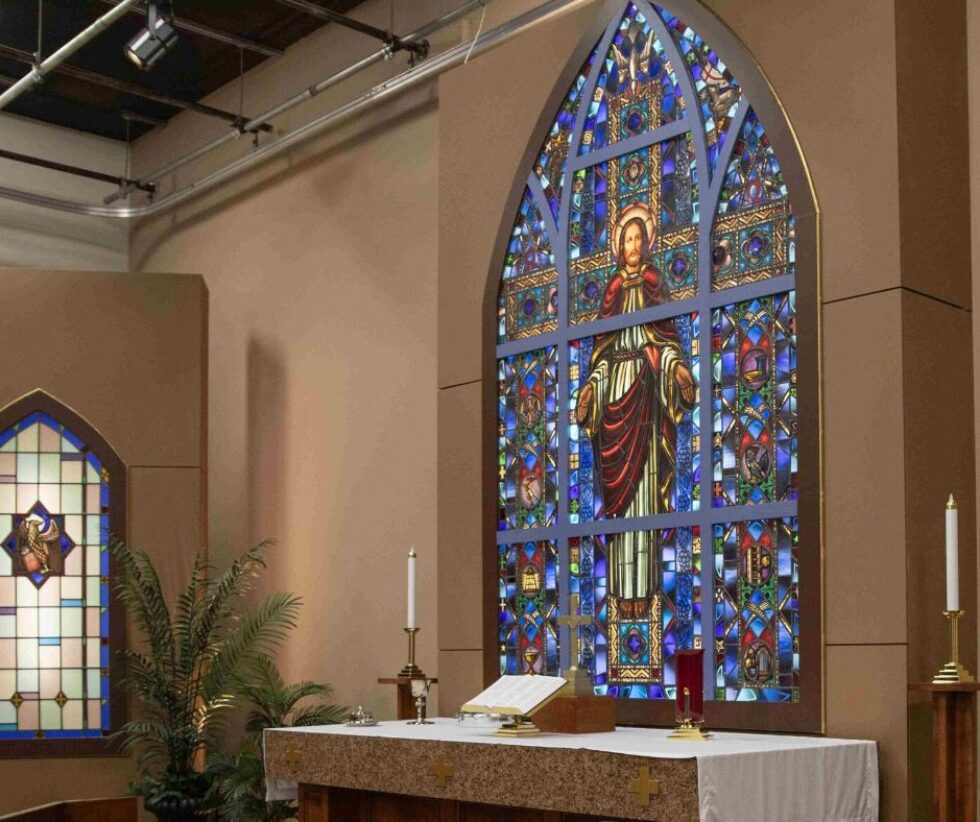
Above photo by Ashley Wiehe: The Chancel serves as a backdrop for “Worship Anew” productions.