


By Rev. Tom Eggebrecht
“The Church’s one foundation is Jesus Christ, her Lord; she is His new creation by water and the Word.” (LSB #644)
Most of us have sung those words so many times that they have become as familiar as breathing. We have sung them in white clapboard churches on the prairie, in city parishes packed with young families, and in sanctuaries that smelled of candle wax and old wood. We have sung them at confirmations and funerals, at anniversaries and installations. The melody lives somewhere deep in us — not just in memory but in faith.
But what happens when the church is tested? What happens when the building is gone, the congregation is aging, the community is shrinking, or the road ahead is uncertain? Do the words still hold?
They do. They always have. And the moments that have proven it most powerfully have never been the easy ones.
A HYMN BORN IN THE FIRE
Samuel Stone did not write “The Church’s One Foundation” from a place of comfort. He wrote it in 1866 — in the middle of a bitter doctrinal controversy that was threatening to fracture the Anglican Communion. The church he loved was in conflict, and Stone responded, not with despair, but with confession — putting into verse what he most deeply believed to be true: that the church’s survival did not depend on its institutions, its leadership, or its circumstances. It depended on Christ alone.
That is a confession the Lutheran church has always understood. It is stitched into our history, our theology, and our hymnal. And it was understood long before Stone ever picked up his pen.
PAUL’S CHURCH HAD NO BUILDING
When the apostle Paul wrote to the church at Philippi, he was in prison. He had no sanctuary, no nave, no steeple. The congregation he was writing to had begun, improbably enough, by a river — a small gathering of women who came to pray, among them a cloth merchant named Lydia whose home became the first meeting place of what would grow into a thriving Christian community.
No building. No endowment. No property committee. And yet, Paul called them his “joy and crown” (Philippians 4:1) and expressed confidence that “He who began a good work in you will bring it to completion at the day of Jesus Christ” (Philippians 1:6).
Paul knew suffering intimately. He knew that the church would face pressure from without and struggle from within. But he also most certainly knew the promise Jesus had made to Peter: that the gates of hell would not prevail against His church (Matthew 16:18). That was not a promise of ease. It was a promise of endurance — a promise that the church built on the rock of Christ would hold, not because of what we bring to it, but because of Who holds it.
The ekklesia — the called-out assembly of believers — was never defined by its address. What made the church at Philippi the church was that the Word was proclaimed, the sacraments were administered, and the people of God bore one another’s burdens (Galatians 6:2). Where those things are present, the church is present.
That truth has been tested in every generation. It was tested in ours not long ago — in a way I witnessed firsthand.
THE CHURCH THAT WOULD NOT END
It had only been a few months since the church burned down. As part of my work with the Lutheran Church Extension Fund, I drove out to see the site before a meeting we were to have that same evening. It was a sad sight — a footprint of ash and debris where a congregation had gathered for years to hear the Word, receive the sacraments, baptize their children, and bury their dead. The kind of place that holds a community’s whole story within its walls. And the walls were gone.
I parked the car there for a while. There is no way to look at something like that without grief. A church building is not just a building — it is layered with memory, with meaning, with the invisible weight of 10,000 ordinary Sundays. To lose it is a real loss, and it deserves to be named as one.
But that very evening, something else happened that deserves to be named just as clearly.
The pastor and lay leaders of that congregation came together with leaders from two neighboring LCMS churches. They did not come to mourn, though they had every right to. They came to work. And out of that evening’s conversation began a process that would result in something none of them had imagined when they woke up that morning — the combination of three congregations into one new church, stronger and more united than any of them had been alone.
The building was gone. The church was not.
In fact, in the ashes of that loss, something that had perhaps grown quiet — the urgent, clarifying sense of what the church actually is — came alive again. They were not three congregations protecting their individual histories. They were the Body of Christ, and they had work to do.
WHAT THIS MEANS FOR US NOW
We all carry our own versions of that story. We have watched beloved congregations struggle. We have seen membership rolls thin, budgets tighten, and buildings that once rang with children’s voices grow quiet. These are real griefs, and they are not nothing.
But they are also not new. The church has always carried its treasure in jars of clay (2 Corinthians 4:7). It has always looked, from the outside, more fragile than it actually is. The congregation by the river looked like nothing much. The letters from the prison cell looked like defeat. The smoking ruins of a sanctuary looked like an ending.
They were not endings. They were, in the hands of God, beginnings.
You may have already survived things that looked unsurvivable. You have held the faith through losses that were supposed to break you and did not. That faithfulness is not a small thing. It is the very thing you are called to hand down.
The church will endure. Jesus has already settled that with His promise, His life, His death, His resurrection, and His ascension.
THE FOUNDATION STILL HOLDS
Samuel Stone ended his hymn with a vision not of struggle but of glory:
“Yet she on earth has union with God, the Three in One, and mystic sweet communion with those whose rest is won.”
The church we belong to is larger than any building, any generation, any controversy. It stretches back to a riverbank in Philippi and forward to the Church Triumphant. It has survived Roman emperors and doctrinal firestorms, prairie winters and parish fires. It will survive whatever comes next.
We are not the last generation of the church. We are one faithful link in a chain that holds — because the One who laid the foundation is still holding it.
“The Church’s one foundation is Jesus Christ, her Lord.”
It always has been. It always will be.
The Rev. Tom Eggebrecht is senior vice president of ministry solutions for Lutheran Church Extension Fund and lives in Winter Springs, Fla.
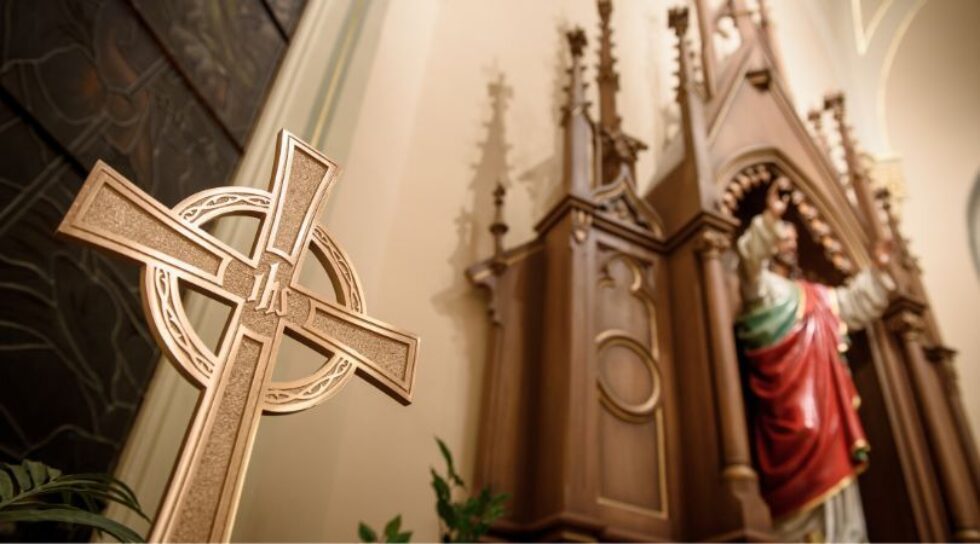
Above Photo courtesy of The Lutheran Church—Missouri Synod: This altar and cross stand in the St. John’s Lutheran Church in Plymouth, Wis.